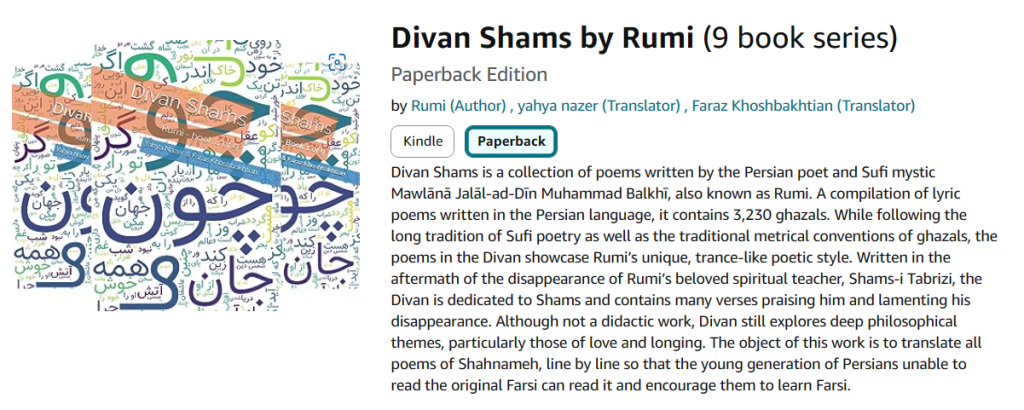
~3,230 ghazals of ecstatic divine love — translated line by line across 9 bilingual volumes. The most rapturous voice in all of Persian mystical literature.
Jalal ad-Din Muhammad Rumi — known in the Persian world as Mawlana (our master) and in the West simply as Rumi — is one of the most widely read poets in the world. Born in Balkh (present-day Afghanistan), he lived most of his life in Konya (present-day Turkey), and wrote almost entirely in Persian.
The Divan-e Shams-e Tabrizi is his lyrical masterwork — over 40,000 verses of ecstatic ghazals and rubaiyat composed in the aftermath of his transformative friendship with the wandering mystic Shams of Tabriz. It is the most passionate, most ecstatic, and most intimate of his works.
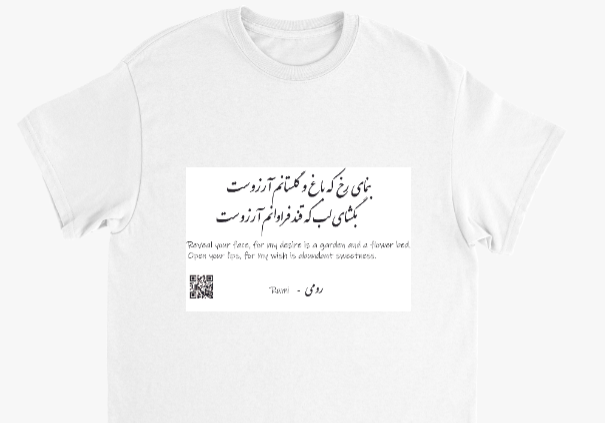
بنمای رخ که باغ و گلستانم آرزوست
بگشای لب که قندِ فراوانم آرزوست
"Reveal your face, for my desire is a garden and a flower-bed —
Open your lips, for my wish is abundant sweetness."
The most famous opening in all of Persian literature — the reed flute crying for separation from the reed-bed, an allegory for the soul's longing for its divine origin.
Jalal ad-Din Muhammad Balkhi was born on 30 September 1207 in Balkh, in present-day Afghanistan, into a family of theologians and Sufi teachers. As a child he fled westward with his family ahead of the Mongol invasion, eventually settling in Konya (present-day Turkey), where he lived until his death in 1273.
Before meeting Shams of Tabriz, Rumi was a respected Islamic scholar and teacher — learned, composed, and conventional. The encounter with Shams in 1244 transformed everything. The two became inseparable spiritual companions, and Rumi experienced a complete dissolution of his former self. When Shams disappeared (and was likely murdered) in 1248, Rumi channelled his grief, love, and longing into poetry of overwhelming intensity.
The Divan-e Shams is the direct outpouring of that transformation — 3,230 ghazals dedicated to and named after Shams of Tabriz. Unlike the more philosophical Masnavi, the Divan is pure song — spontaneous, ecstatic, and radically intimate. Rumi sometimes signed these poems not with his own name but with the name "Shams" — so completely had his identity merged with that of his teacher.
The friendship between Rumi and Shams of Tabriz is one of the most celebrated relationships in the history of mystical literature — and the direct cause of the Divan-e Shams.
Shams was a wandering dervish, unconventional, forceful, and spiritually electrifying. When he arrived in Konya in 1244, Rumi recognised in him something that shattered his existing world completely. For months, the two were inseparable — locked in spiritual conversation that excluded everyone else around them.
When Shams disappeared — likely killed by Rumi's jealous disciples in 1248 — Rumi twice travelled to Damascus searching for him. He never found him. He spent the rest of his life transmuting that unbearable grief into poetry. Every ghazal in the Divan-e Shams is, in some sense, addressed to Shams — to his face, his lips, his presence, his absence.
Born into a family of Sufi scholars — his father Baha ud-Din Walad was a respected theologian and mystic.
The family departs Balkh ahead of the Mongol invasion — a journey westward through Persia, Anatolia, Arabia. The young Rumi meets Attar in Nishapur.
The family settles in Konya (present-day Turkey) under the patronage of the Seljuq sultanate. Rumi becomes a respected Islamic scholar and teacher.
The wandering mystic Shams of Tabriz arrives and encounters Rumi. Their meeting transforms Rumi entirely — the scholar becomes a poet of ecstasy.
Shams is murdered (likely by Rumi's jealous disciples). Rumi searches twice in Damascus. The grief becomes the Divan-e Shams.
Rumi composes the Masnavi — 6 books, 25,000+ couplets of mystical philosophy. Dies in Konya on 17 December 1273. His tomb draws pilgrims to this day.
Rumi was phenomenally prolific. Alongside the Divan-e Shams, he produced the six-book Masnavi, collected discourses, and letters — a body of work that has made him one of the most translated poets in the world.
~3,230 ghazals and ~2,000 rubaiyat — the ecstatic lyric poems of divine love. Named after and dedicated to Shams of Tabriz. Translated in 9 bilingual volumes.
Six books, 25,700 couplets — a vast mystical poem in rhyming couplets. The "Quran in Persian" as it has been called. Opens with the famous Reed's Lament.
A collection of Rumi's prose discourses — recorded by his son Sultan Walad. Spiritual teachings, commentary on the Quran, and reflections on mystical states.
Rumi's collected correspondence — letters to patrons, students, and friends, showing a more personal, human side of the poet alongside his mystical persona.
Seven recorded public sermons by Rumi — a window into his role as a teacher and spiritual guide, before the transformation wrought by Shams.
~2,000 quatrains attributed to Rumi — compact four-line verses that capture single moments of mystical insight with the same intensity as his longer ghazals.
The Masnavi opens with eighteen couplets known as the "Nay-Nama" (Reed's Letter) or "Beshno in Ney" (Listen to the Reed) — widely considered the most famous opening in all of Persian literature, and perhaps one of the most profound allegories in world poetry.
The reed (ney) has been cut from the reed-bed and cries for separation — just as the human soul has been separated from its divine origin and longs to return. The reed's crying is music, and that music is both the wound of separation and the beauty that comes from it.
Our bilingual edition presents the full Masnavi alongside the Divan-e Shams — allowing readers to experience both dimensions of Rumi's genius: the lyrical ecstasy of the ghazal and the narrative depth of the masnavi.
~70,000 lines of the Divan-e Shams translated line by line — plus two new companion editions: The Essential Rumi (the actual Persian poems behind Coleman Barks' famous translations) and Rumi — Soul of Love (46 selected ghazals). All available in Kindle and Paperback on Amazon.
Forty-six of the most celebrated ghazals from the Divan-e Shams, translated line by line — a perfect introduction to Rumi's lyrical voice for new readers.
Buy on AmazonA selection of celebrated opening couplets from the Divan-e Shams — each one the beginning of a complete ghazal available in the bilingual edition.
| # | Opening Line — English | Theme | مطلعِ غزل |
|---|---|---|---|
| 1 | "Reveal your face, for my desire is a garden and a flower-bed — open your lips, for my wish is abundant sweetness." | The Beloved's beauty | بنمای رخ که باغ و گلستانم آرزوست |

| 2 | "Out beyond ideas of wrongdoing and rightdoing there is a field — I'll meet you there." | Transcendence | بیرون ز وَهمِ نیک و بد، صحرایی است |
| 3 | "Come, come whoever you are — wanderer, worshiper, lover of leaving — it doesn't matter." | Universal welcome | بیا بیا هر که هستی، بیا |
| 4 | "I died as mineral and became a plant — I died as plant and rose to animal. I died as animal and I was man." | The soul's evolution | از جمادی مُردم و نامی شدم |
| 5 | "This human being is a guest house — every morning a new guest arrives." | Acceptance | این آدمی را مهمانخانه دان |
| 6 | "Silence is the ocean of knowledge — speech is its shore. The ocean sends waves and the shore is its manifest sign." | Silence & knowledge | خاموشی دریایِ علم است و کلام |
| 7 | "You were born with wings — why prefer to crawl through life?" | Human potential | بال داری، چرا خاک میخوری؟ |
| 8 | "The wound is the place where the light enters you." | Suffering & grace | زخم آن جایی است که نورت وارد میشود |
| 9 | "When I am with you we stay up all night — when you're not here I can't go to sleep. Praise God for these two insomnias." | Love's two faces | شب که با توام نخوابم، شب که نیستی نخوابم |
| 10 | "Your task is not to seek for love, but merely to seek and find all the barriers within yourself that you have built against it." | Inner barriers | کارِ تو عشق جستن نیست |
| 11 | "Let the beauty we love be what we do — there are hundreds of ways to kneel and kiss the ground." | Worship & beauty | بگذار زیباییای که دوست داریم کارِ ما باشد |
| 12 | "Forget safety — live where you fear to live. Destroy your reputation — be notorious." | Spiritual courage | ایمنی را فراموش کن — جایی زی که از آن میترسی |
| 13 | "Why do you stay in prison when the door is so wide open?" | Liberation | چرا در زندان میمانی که در آنچنان باز است؟ |
| 14 | "Sell your cleverness and buy bewilderment — cleverness is mere opinion, bewilderment is intuition." | Beyond reason | زیرکی را بفروش و حیرت بخر |
| 15 | "Run from what is comfortable — forget safety, live where you fear to live." | Growth & risk | از آنچه راحت است بگریز |
Wear a couplet from Rumi's Divan-e Shams — Farsi on the front, English on the back. Heavyweight unisex crewneck, all sizes available on Etsy.